
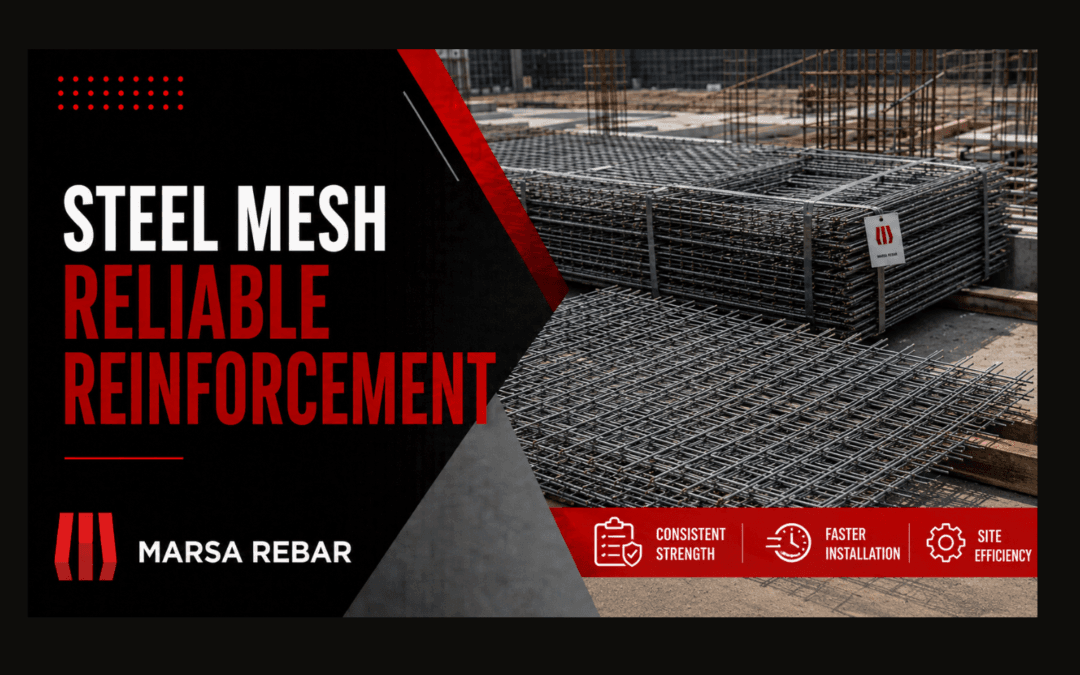
When a programme is tight and reinforcement errors carry real cost, electro-welded steel mesh becomes less about convenience and more about control. For contractors, engineers and procurement teams, it offers a practical way to achieve repeatable spacing, faster fixing and more predictable site performance across slabs, pavements and foundations.
That matters because reinforcement is rarely judged only on what arrives at the gate. It is judged on whether it fits the pour sequence, supports structural intent, reduces avoidable labour on site and arrives when the job needs it. In that respect, electro-welded mesh is often one of the most efficient reinforcement products available, provided it is specified correctly and supplied with the same discipline as the rest of the reinforcement package.
What electro-welded steel mesh is used for
Electro-welded steel mesh is formed by electrically welding intersecting steel wires or bars into a consistent grid. The result is a reinforcement product with fixed spacing and dependable dimensional accuracy, making it suitable for applications where uniform distribution of steel is required.
In practice, it is widely used in ground-bearing slabs, suspended slabs, retaining walls, screeds, roadworks, precast elements and foundation systems. On many projects, it is chosen because it simplifies installation compared with placing large volumes of loose bar individually. The mesh arrives ready to place, which can reduce fixing time and help teams maintain progress during busy programme phases.
The key advantage is consistency. With individual bars, site teams must control spacing, overlap and alignment piece by piece. With mesh, much of that control is built into the product itself. That does not remove the need for correct placement, cover and laps, but it does reduce opportunities for variation.
Why electro-welded steel mesh improves site efficiency
On a live construction site, time is shaped by details. Delays often come from rework, missing materials, awkward sequencing or labour being pulled into avoidable tasks. Electro-welded steel mesh helps by reducing the amount of handling and positioning required for many standard reinforcement zones.
For slab works in particular, the speed benefit is clear. Larger areas can be covered more quickly, and fixing teams can work to a more predictable rhythm. That supports better labour planning and can shorten the reinforcement stage ahead of concrete placement. Where pour dates are fixed and access windows are limited, that reliability has commercial value.
There is also a material control benefit. Because mesh is manufactured to set dimensions and steel distribution, it can help reduce waste associated with excessive cutting and inconsistent bar placement. This is especially relevant on projects where procurement teams are watching both cost control and installation efficiency.
That said, mesh is not always the answer everywhere. Complex junctions, congested zones, heavily detailed structural elements and irregular geometries may still require cut and bent rebar or bespoke reinforcement assemblies. The most efficient projects are rarely built around one product alone. They combine mesh with other reinforcement solutions in a way that reflects the structure, access conditions and programme demands.
Specifying welded mesh with the structure in mind
Good reinforcement outcomes start well before delivery. Mesh should be selected according to structural requirements, loading conditions, slab thickness, support arrangement, crack control needs and relevant design standards. If any one of those factors is treated too loosely, the result may be poor fit, unnecessary site adjustment or delays in approval.
Engineers generally look at bar diameter, spacing, sheet size, lap requirements and placement level. Procurement teams and project managers then need to consider whether the selected mesh format suits site handling, storage and installation logistics. A technically suitable mesh sheet that is difficult to unload, move or place in confined conditions may create site problems of its own.
This is where supplier coordination matters. A dependable reinforcement partner does more than process an order. They help align fabrication, sheet selection, quantities and delivery sequencing with the realities of the programme. On projects where timing is tight, that level of coordination can make the difference between a smooth pour and a lost day.
Quality control is not optional
Reinforcement products only perform as intended when quality is controlled from manufacture through delivery and placement. With electro-welded steel mesh, that means paying close attention to steel grade, weld integrity, dimensional accuracy and handling procedures.
Poorly manufactured mesh can introduce problems that are expensive to correct on site. Inconsistent dimensions may affect laps and coverage. Damage during transport or unloading may distort sheets and slow fixing. If traceability is weak, approval and inspection can become more complicated than they need to be.
For commercial and infrastructure projects, reliability is built on process. Materials should be produced to specification, checked properly and delivered in a condition that allows immediate use. This is not only about compliance. It is about protecting programme certainty and structural performance.
Construction teams in Malta often work under demanding site conditions, with restricted access, tight urban footprints and limited tolerance for disruption. In that environment, reinforcement supply has to be disciplined. Marsa Rebar approaches mesh and fabricated reinforcement with that standard in mind; precision, dependable production and delivery planning that supports the work on site rather than complicating it.
Handling, storage and installation on site
Even high-quality mesh can underperform if it is handled poorly after arrival. Sheets should be stored on suitable supports, kept stable and protected from unnecessary distortion. Site teams should avoid dragging or forcing sheets into place where that may compromise alignment or create safety issues.
Installation accuracy still matters. Mesh must be placed at the correct level, with appropriate laps, tying and cover. Chairs, spacers and supports should be selected to keep reinforcement in position during concrete placement. If mesh is left unsupported or displaced during the pour, the benefit of the product is quickly lost.
There is also a sequencing point to consider. Mesh installation is fastest when deliveries are organised in the order the job needs them. If crews have to sort through mixed stacks to find the right sheets, time is wasted and the risk of damage increases. Clear identification and planned delivery schedules are therefore as important as the mesh itself.
Where mesh works best – and where bespoke reinforcement is better
Electro-welded steel mesh is especially effective in repetitive or open-plan reinforcement areas where uniform steel distribution is the main requirement. Large floor slabs, external hard standings, transfer areas, pavements and some wall applications are typical examples. In these settings, the balance of speed, consistency and labour efficiency is hard to ignore.
However, some structures are too detailed or too congested for standard mesh to be the main solution. Lift cores, beam-column junctions, curved forms, heavily reinforced foundations and specialist infrastructure details often call for cut and bent rebar, links or pre-assembled cages. The issue is not that mesh is inadequate. It is that reinforcement must fit the structure, not the other way round.
For project teams, the better question is not whether mesh is better than loose bar in general. It is where mesh improves productivity without compromising design intent. Once that is clear, reinforcement can be planned as a coordinated package rather than a series of separate purchases.
Choosing a supplier for electro-welded steel mesh
Price always matters, but it should never be the only measure. For reinforcement products, the real cost sits in the full chain: fabrication accuracy, availability, delivery timing, product condition on arrival and responsiveness when programme changes occur.
A capable supplier should be able to confirm specification clearly, maintain quality control, provide realistic lead times and support delivery planning that reflects the site sequence. They should also understand how mesh fits into the broader reinforcement requirement, especially on projects where standard sheets and bespoke elements are used together.
This is where long-term partnerships usually outperform transactional buying. When a supplier understands the project, they can anticipate pressure points, coordinate more effectively and reduce the risk of disruption. For contractors and developers, that means fewer surprises and stronger control over installation phases.
Electro-welded steel mesh remains one of the most practical reinforcement products in modern construction because it solves a real site problem; how to place steel accurately and efficiently at scale. Used in the right locations, manufactured to the right standard and delivered with proper coordination, it supports faster progress, cleaner installation and dependable structural performance. The strongest results come when reinforcement supply is treated as part of project execution, not just another item on the order sheet.