
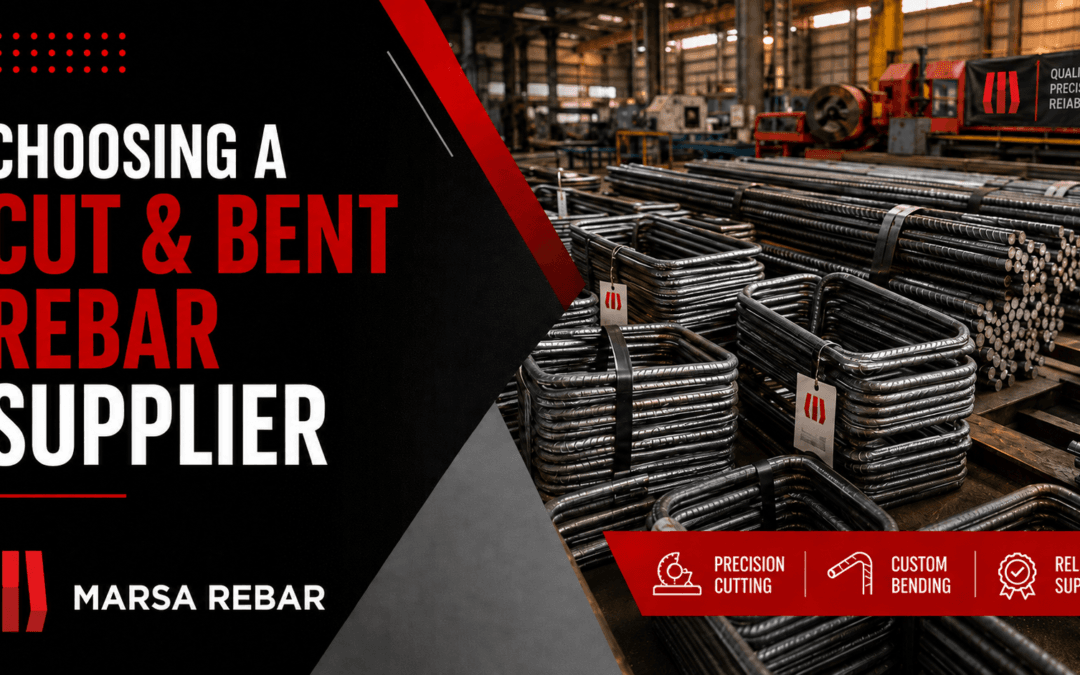
A delayed pour rarely starts with concrete. More often, it starts earlier, with reinforcement that arrives late, arrives wrong, or creates unnecessary cutting and adjustment on site. That is why choosing the right cut and bent rebar supplier matters well beyond procurement. It affects programme certainty, labour efficiency, waste control, and ultimately the structural quality of the build.
For contractors, developers, and engineers, cut and bent reinforcement is not simply a convenience. It is a practical way to reduce site handling, improve installation speed, and make sure steel is fabricated to the approved schedule before it reaches the project. The value, however, depends on the supplier’s ability to deliver consistent accuracy and dependable service, not just the material.
What a cut and bent rebar supplier should really provide
A capable cut and bent rebar supplier does more than process bar to length and shape. The real role is to translate drawings, bending schedules, and project requirements into reinforcement that is ready for installation with minimal intervention on site. That requires fabrication discipline, quality checks, clear identification, and production planning that matches project sequencing.
In practice, this means each bundle or item needs to support the flow of work, not interrupt it. If bars are inaccurately bent, poorly labelled, or delivered without regard to installation order, site teams lose time sorting, correcting, and compensating. Any apparent saving in unit price can quickly disappear through labour inefficiency and programme disruption.
A reliable supplier will also understand that reinforcement packages rarely exist in isolation. Cut and bent bar often needs to align with mesh, links, cages, and project-specific assemblies. Coordination across these elements helps reduce confusion on site and supports steadier progress through each construction phase.
Why fabrication accuracy matters from day one
Reinforcement tolerances are not simply an administrative detail. They influence fit, cover, congestion, and ease of placement. On straightforward work, small inaccuracies may still create avoidable delays. On heavily reinforced structural elements, the consequences can be more serious, especially where bars need to sit precisely around openings, starter bars, embedded items, or dense connection zones.
Accuracy begins with proper schedule interpretation and continues through cutting, bending, checking, and handling. It also depends on using controlled fabrication processes rather than treating every order as a basic commodity. When reinforcement is made correctly the first time, site teams can place it with confidence, inspections become smoother, and the risk of last-minute remedial work is reduced.
There is also a waste issue. Buying stock lengths and processing on site often leads to offcuts, inconsistent bends, and unnecessary material movement. Cut and bent rebar shifts that work into a controlled production environment, where bars are manufactured to specification and waste can be managed more efficiently.
The cost question is not just the rate per tonne
Procurement decisions are often pressured by price comparison, and that is understandable. Yet reinforcement supply should be measured against total project impact, not only the headline rate. A cheaper source that misses delivery windows or produces repeated fabrication errors can become more expensive once site labour, plant standing time, and sequencing delays are factored in.
The better question is whether the supplier helps the project move forward predictably. When fabricated steel arrives ready to install, correctly tagged, and in the agreed sequence, the operational value is immediate. That is especially relevant on busy sites in Malta where storage space, lifting windows, and access can all place pressure on delivery planning.
Common issues that create delays on site
Most reinforcement problems are avoidable, but they usually start with weak coordination rather than dramatic failure. Bars that are not labelled clearly can slow fixing crews. Deliveries that arrive too early can create storage and handling problems. Deliveries that arrive too late can hold up concrete works, shuttering sequences, or follow-on trades.
Another common issue is poor translation between design intent and fabrication output. If schedules are unclear and the supplier does not raise questions promptly, errors can pass through production and appear only when the steel is being installed. At that point, the site carries the disruption.
This is where partnership matters. A dependable reinforcement supplier does not simply wait for instructions and dispatch steel. They work proactively to identify potential issues, confirm details, and support smoother execution. That service approach is often the difference between a transactional supply arrangement and a dependable long-term relationship.
Bespoke fabrication can improve site efficiency
Not every project requires the same reinforcement solution. Residential work, commercial structures, and infrastructure packages each bring different constraints around complexity, volume, access, and sequencing. A supplier with bespoke fabrication capability can respond more effectively to those differences.
For example, pre-assembled cages or custom links may reduce tying time and improve consistency in repetitive structural elements. On the other hand, some projects benefit more from phased deliveries of standard cut and bent bar to match limited site storage. There is no single best model for every job. The right approach depends on design complexity, programme pressure, labour availability, and installation methodology.
A supplier that understands those variables can recommend a practical fabrication and delivery strategy rather than simply quoting a list of products. That kind of support is particularly valuable when project teams are trying to balance speed, quality, and cost without compromising compliance.
What contractors and developers should ask before placing an order
Before committing to a supplier, decision-makers should look beyond availability and price. Ask how fabrication accuracy is checked, how bars are identified for site use, how delivery schedules are managed, and how quickly changes can be processed when drawings are revised. It is also sensible to ask what happens when urgent requirements arise. The answer will reveal a great deal about operational readiness.
You should also consider whether the supplier can support a broader reinforcement package. Managing cut and bent bar, mesh, links, cages, and fabricated assemblies through one dependable partner can simplify procurement and improve coordination. That is not always necessary, but on larger or more complex jobs it often reduces interface risk.
For many buyers, consistency is the deciding factor. One successful delivery is useful. Repeated, accurate, on-time supply across the life of a project is what builds trust. That is where an experienced specialist such as Marsa Rebar adds value – not only through fabrication capability, but through dependable service that supports site performance from planning through delivery.
How to assess a cut and bent rebar supplier
The strongest suppliers tend to distinguish themselves in a few practical areas. First is technical competence. They should be comfortable working from schedules and drawings, clarifying discrepancies early, and fabricating consistently to specification. Second is quality control. Reinforcement needs to be checked before dispatch, not left for site teams to discover issues during fixing.
Third is logistics reliability. On-time delivery is not a marketing promise in construction; it is part of project performance. Fourth is responsiveness. Projects evolve, and reinforcement orders often need revisions, additions, or phased call-offs. A supplier that can adapt without losing control of quality becomes a practical asset to the job.
It is also worth assessing how the supplier supports visibility. Real-time tracking, clear documentation, and accessible customer support can make a substantial difference when teams are coordinating multiple work fronts. Good communication reduces uncertainty, and reduced uncertainty helps keep installation teams productive.
The supplier choice affects the whole build
Reinforcement sits early in the construction sequence, which means mistakes here tend to travel forward. If steel is late, the pour is late. If steel is wrong, labour is diverted and inspections become harder to manage. If steel is right, correctly fabricated and delivered when needed, the rest of the programme has a better chance of staying on track.
That is why the choice of supplier should be treated as an operational decision, not just a purchasing exercise. The right partner helps reduce waste, protect quality, and keep progress steady under real site conditions. In a market where schedules are tight and expectations are high, dependable fabrication and delivery are not extras. They are part of building properly from the start.
When reinforcement is manufactured with precision and supplied with discipline, the project team can spend less time correcting problems and more time moving the job forward.