
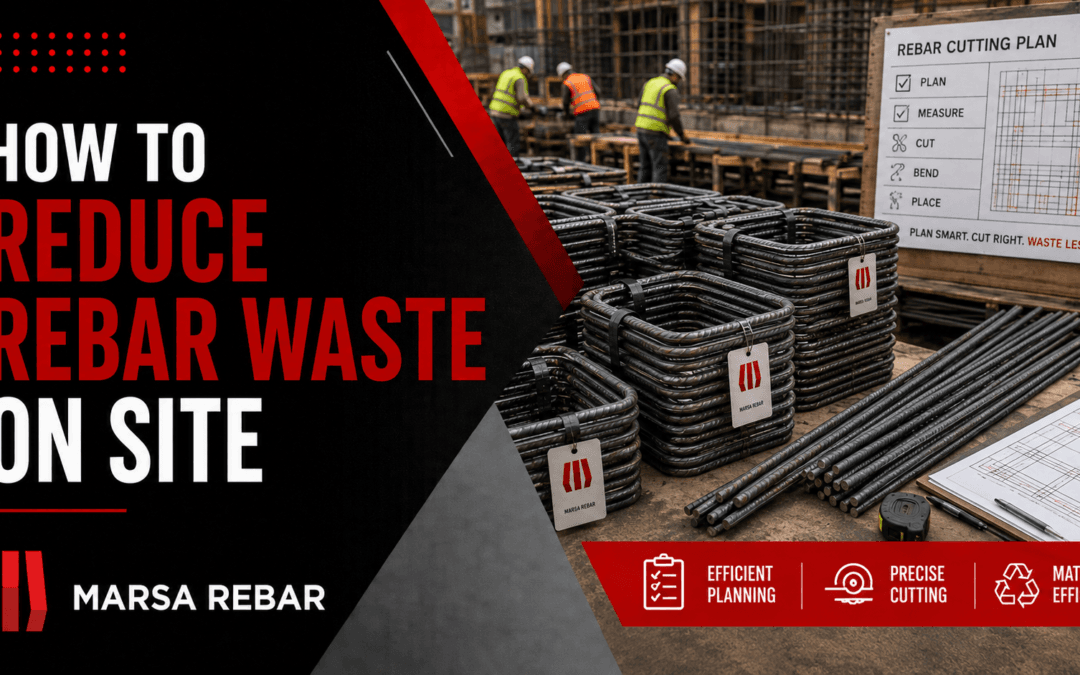
A few tonnes of wasted reinforcement rarely start as a major problem. More often, they come from small decisions made too early, too late, or without the right coordination between design, fabrication and site teams. For contractors and project managers asking how to reduce rebar waste, the answer is not one change on its own. It comes from tighter planning, better fabrication data and more disciplined handling from order to installation.
Rebar waste affects more than material cost. It adds labour, creates storage and handling issues, increases scrap on site and can slow installation when the steel available no longer matches the fixing sequence. On fast-moving projects, those losses are felt in programme pressure as much as in procurement spending.
Why rebar waste happens in the first place
Most waste is created before the steel reaches the site. Over-ordering, unclear bar schedules, late design revisions and poor coordination between drawings and fabrication all contribute to surplus or unusable material. Even when the quantities look correct on paper, avoidable losses often appear during cutting, bending, transport and storage.
There is also a difference between planned process loss and preventable waste. Some offcuts are inevitable depending on stock lengths, bar diameters and bending requirements. What matters is whether that loss has been accounted for and minimised. A controlled fabrication process will always perform better than cutting ad hoc on site.
Projects with multiple pours, phased access or constrained storage face an extra challenge. If reinforcement arrives too early, gets moved repeatedly or is exposed to damage, the risk of waste rises quickly. In other words, reducing waste is as much a logistics issue as a procurement one.
How to reduce rebar waste through better planning
The strongest gains usually come at the pre-construction stage. If reinforcement requirements are reviewed early, teams can align structural intent with practical fabrication lengths, bar marks and installation sequencing. That reduces last-minute cutting and the temptation to solve problems on site with substitutions that create leftover steel.
Accurate bar bending schedules are critical. When schedules are incomplete, inconsistent or issued late, fabricators and site teams are forced to work with assumptions. That is where waste starts to build. A clean, checked schedule gives procurement teams confidence in quantities and allows fabrication to be optimised around actual project demand.
Design coordination also matters. Revisions are normal, but poorly managed revisions are expensive. If superseded drawings remain in circulation or updates are not reflected clearly in the schedule, previously fabricated material can become redundant. The cost is not just the steel itself. It is the delay, the handling and the effort needed to reorder and reprogramme works.
For larger developments, phased reinforcement planning often makes better commercial sense than one large bulk order. It limits exposure damage and allows quantities to be refined as work fronts progress. The trade-off is that delivery planning needs to be stronger because the margin for timing errors becomes smaller.
Use cut and bent rebar instead of site cutting
One of the most effective ways to reduce waste is to move cutting and bending away from the site and into a controlled fabrication environment. Cut and bent rebar produced to project specification gives teams the exact lengths and shapes required, which removes a significant amount of guesswork during installation.
This approach reduces offcuts, improves traceability and helps site teams work from marked, ready-to-fix steel rather than raw stock lengths. It also limits the space, labour and supervision needed for processing reinforcement on site. For busy commercial and infrastructure projects, that can make a meaningful difference to productivity and housekeeping.
There are, however, conditions. Fabrication accuracy depends on the quality of the input information. If the schedule is wrong, precisely fabricated steel will still be wrong. That is why experienced contractors focus not only on buying fabricated reinforcement, but on working closely with a supplier that can support order review, sequencing and revision control.
Match orders to the construction sequence
Waste often rises when reinforcement is purchased by theoretical total quantity rather than by installation need. Ordering everything early may appear efficient, but it can create congestion, double handling and unnecessary exposure to design change. On constrained sites in particular, too much steel at once can become its own source of loss.
A better approach is to align supply with the actual programme. Deliver what is needed for the next work phase with enough visibility to maintain continuity but not so much that material sits idle. This is especially important where excavation, formwork and concrete operations are changing rapidly.
Sequenced deliveries also make stock control more reliable. Site teams can identify shortages or discrepancies earlier, and procurement teams can adjust future releases before problems multiply. Trusted fabrication partners support this by coordinating production and delivery windows closely with project requirements.
Improve site storage and handling
Even well-fabricated reinforcement can become waste if it is poorly managed after delivery. Bars mixed by diameter or bar mark, bundles stored on uneven ground or steel placed where plant movement is heavy all increase the risk of damage, loss and installation error.
Clear receiving procedures help. Delivered material should be checked promptly against schedules and labelled in a way that matches the fixing sequence. When steel is stored by pour area or structural zone, fixers spend less time sorting through stock and are less likely to cut bars unnecessarily because the correct material cannot be found.
Protection matters too. While reinforcement is designed for tough service conditions, poor site storage can still affect usability and handling. Keeping bundles organised, accessible and away from avoidable contamination supports both quality and waste reduction.
Train teams to treat reinforcement as a planned product
Rebar waste is not only a supply chain issue. It is also a site culture issue. Where reinforcement is treated as a generic commodity, site-level decisions tend to favour speed over control. Bars are trimmed to fit, substitute pieces are used without checking and valuable offcuts are left without any clear reuse plan.
By contrast, projects with lower waste tend to treat reinforcement as a planned product with fixed dimensions, sequencing and compliance requirements. Site supervisors, fixers and procurement teams work from the same information, and any deviation is escalated before steel is altered.
That does not mean every offcut can be eliminated. Some residual material is unavoidable. The goal is to stop avoidable waste caused by poor communication or casual handling. Better bar mark visibility and clear sign-off procedures can have a larger effect than many teams expect.
Work with a supplier that helps prevent waste
The supplier relationship has a direct effect on waste performance. A reinforcement partner that simply processes orders may still leave the contractor to absorb the cost of unclear schedules, impractical releases and poorly timed deliveries. A more capable supplier adds value by identifying quantity issues early, fabricating accurately and delivering in line with site readiness.
This is where service quality becomes commercially important. Precision fabrication, dependable lead times and real-time coordination reduce the number of situations where steel has to be recut, replaced or stored longer than planned. On projects where programme certainty matters, that operational support is often worth more than a narrow focus on unit rate.
For many contractors, the best results come from suppliers who understand both fabrication efficiency and site realities. Marsa Rebar supports this model by combining made-to-specification reinforcement with dependable delivery coordination, helping project teams reduce waste without adding complexity to the build programme.