
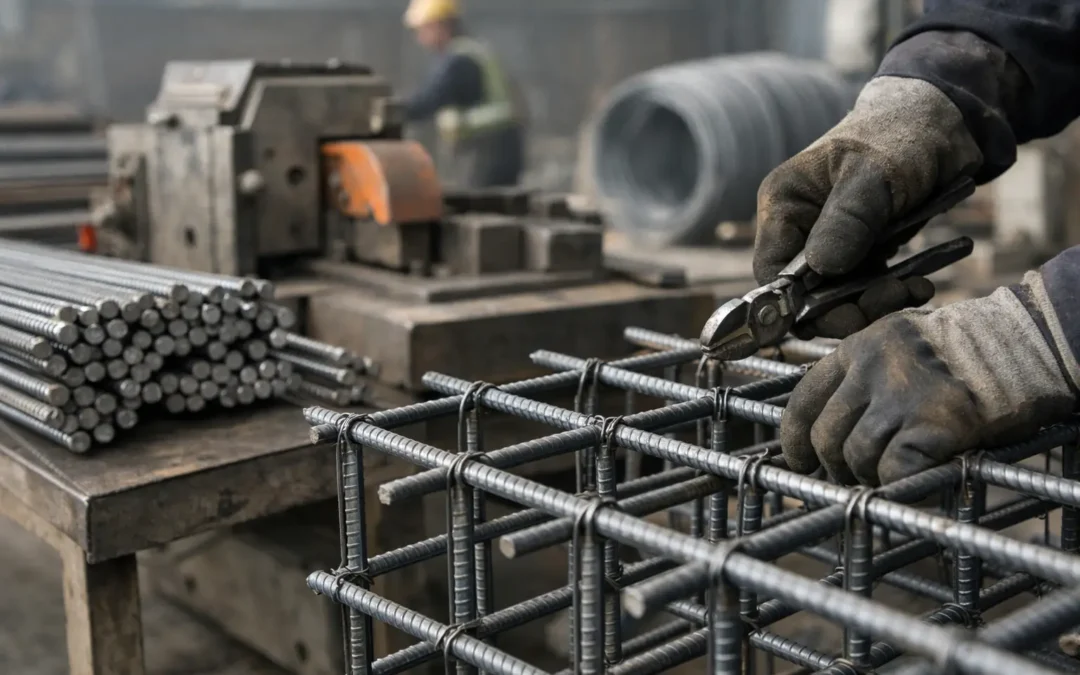
A delayed pour rarely starts with concrete. More often, the problem begins earlier – with reinforcement that arrives late, does not match the drawings, or creates avoidable fixing issues on site. That is why reinforcing steel fabrication matters far beyond the fabrication yard. Done properly, it supports programme certainty, cleaner installation, better material control, and the structural performance the design depends on.
For contractors, developers, and engineers, reinforcement is not a commodity in the practical sense. The steel may be standard by grade, but the fabricated output is highly specific to the structure, the sequencing of works, and the working conditions on site. Precision is what turns bar schedules into installable reinforcement.
What reinforcing steel fabrication involves
Reinforcing steel fabrication is the process of converting straight reinforcing bar and wire products into project-specific items ready for installation. That usually includes cutting, bending, bundling, tagging, and preparing reinforcement to match approved bar bending schedules and structural drawings. Depending on the requirement, it can also include welded mesh, links, starter bars, pre-assembled cages, and electro-welded steel frames.
This is not simply a manufacturing step. It is a coordination function between design intent and site execution. The fabricator must interpret schedules accurately, apply the correct bend dimensions and tolerances, organise production in the right sequence, and deliver material in a form the site team can install efficiently.
Where projects become more complex, the value of fabrication increases. Basement retaining walls, suspended slabs, lift cores, columns, beams, pile caps, and infrastructure elements all rely on reinforcement that fits first time. A few millimetres out in a critical cage or link set can slow progress quickly, particularly where congestion is high or concrete cover is tight.
Why accuracy in reinforcing steel fabrication matters
Accuracy affects more than workshop quality. It has a direct effect on labour productivity, waste levels, and programme reliability. If bars are cut short, bent incorrectly, or grouped poorly for delivery, the site team loses time sorting, adjusting, and requesting replacements. Those costs rarely sit neatly in one budget line, but they are very real.
Good fabrication reduces those disruptions. When reinforcement arrives clearly identified, correctly formed, and matched to the pour sequence, installation is faster and safer. Fixers spend more time placing steel and less time solving preventable issues. Procurement teams gain better control over quantities. Project managers have fewer delays caused by missing or unsuitable reinforcement.
There is also a structural dimension. Reinforcement placement is governed by design assumptions around bar diameter, spacing, anchorage, laps, and cover. Fabrication errors can interfere with those assumptions, especially in heavily reinforced sections. While some issues can be corrected on site, many should not be. Excessive site bending or unplanned substitutions can compromise compliance and create inspection problems.
The process behind dependable fabrication
A dependable fabrication service starts before any steel is cut. The first requirement is careful review of the bar bending schedule, drawings, revisions, and quantities. This stage matters because fabrication errors often originate in document control rather than production. If superseded information reaches the yard, accuracy in cutting and bending will not save the project from the wrong output.
Once requirements are confirmed, the steel is processed according to the specified shapes, lengths, and bend details. Production control is critical here. Machines must be calibrated, tolerances monitored, and batches checked for consistency. Quality control is not a final inspection exercise alone. It needs to run through the entire workflow.
After fabrication, identification and handling become just as important as forming. Bars must be bundled, labelled, and prepared in a way that supports unloading and installation on site. This is where operational discipline separates a reliable partner from a basic supplier. Reinforcement that is technically correct but poorly packed can still create delays once it reaches site.
Delivery planning is the final part of the process. Large projects rarely benefit from all steel arriving at once. The more useful model is phased supply aligned with programme demands, storage constraints, and workfront readiness. Real value comes from supplying the right fabricated reinforcement at the right time, not simply from producing it.
Reinforcing steel fabrication and waste reduction
Waste on construction projects is often discussed in terms of over-ordering or damaged material, but fabrication strategy plays a major role too. When reinforcement is fabricated to specification, quantity control improves and unnecessary site alterations fall away. That means less scrap, fewer emergency orders, and better use of labour.
It also improves site organisation. Straight stock lengths can be difficult to manage on constrained sites, particularly in urban or multi-storey builds. Pre-cut and bent reinforcement reduces site processing and limits the space needed for handling. For project teams working under pressure, that is not a minor convenience. It helps maintain safer working areas and cleaner programme flow.
There is a trade-off, however. Bespoke fabrication requires accurate and stable information. If design changes continue deep into production, rework can still occur. The answer is not to avoid fabrication. It is to work with a supplier that can respond quickly to revision control, communicate clearly, and adjust production without losing traceability or delivery discipline.
When bespoke fabrication adds the most value
Not every project requires the same level of fabrication complexity. Standard residential work may rely heavily on common shapes and mesh, while commercial and infrastructure projects often need a higher proportion of tailored reinforcement packages. The more complex the geometry, congestion, and sequencing, the more valuable a specialist fabrication partner becomes.
Pre-assembled cages are a good example. They can save considerable installation time where repetitive structural elements are involved, or where access and labour efficiency are major concerns. The same applies to electro-welded steel frames and custom link sets for columns and beams. These products can improve consistency and speed, but only when produced to the right tolerances and delivered in the right order.
For procurement teams, the decision is usually commercial as well as technical. A lower unit rate on basic supply can be attractive at tender stage, but it may not reflect the full site cost if that material arrives with poor sequencing, inconsistent labelling, or unreliable lead times. In practice, dependable fabrication often delivers better project value than a cheaper but less controlled supply route.
Choosing a reinforcing steel fabrication partner
A capable fabrication partner should offer more than processing capacity. The real test is whether they can support the project from planning through delivery. That means understanding specifications, managing revisions, maintaining quality checks, and coordinating logistics with the same discipline applied in production.
For decision-makers, a few questions matter. Can the supplier handle both standard and bespoke reinforcement? Do they maintain clear traceability across batches and deliveries? Can they align supply with phased programmes rather than forcing the site to absorb stock too early? Do they communicate in a way that helps engineers, buyers, and site teams work from the same information?
Service reliability should be assessed alongside technical competence. Delays in reinforcement supply have a knock-on effect across formwork, fixing, inspections, concrete pours, and follow-on trades. A fabrication partner that understands this chain is far more useful than one focused only on tonnage output.
This is where a specialist business such as Marsa Rebar adds value – not only by supplying cut and bent rebar, welded mesh, links, cages, and fabricated steel frames, but by treating reinforcement as a coordinated project requirement rather than a simple material order.
What good looks like on a live project
On a well-run job, fabricated reinforcement arrives tagged, accurate, and ready for the planned workfront. Site teams know what each bundle is for. Engineers can inspect against drawings without chasing substitutions. Procurement has visibility on upcoming deliveries. Project managers are not forced into reactive changes because critical reinforcement is missing or unusable.
That standard does not happen by accident. It comes from fabrication accuracy, disciplined quality control, dependable logistics, and supplier communication that stays consistent under pressure. When those elements are in place, reinforcement stops being a source of friction and becomes what it should be – a dependable part of project delivery.
Construction programmes are tight, margins are watched closely, and site teams do not have time to correct preventable errors. Reinforcing steel fabrication is most valuable when it removes uncertainty before the material reaches site. For projects that need precision and dependable execution, that is not an added extra. It is part of building properly from the start.