
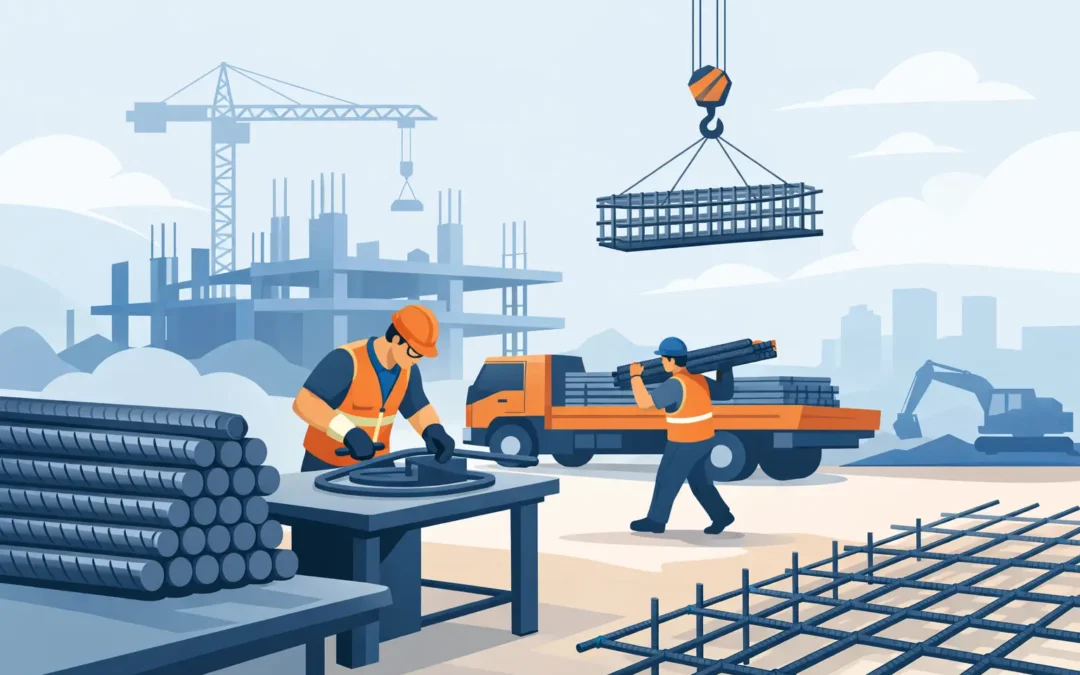
A reinforcement schedule can look straightforward on paper, then create delays on site the moment a bar arrives out of tolerance or a delivery misses its slot. That is where rebar steel fabrication stops being a back-office process and becomes a critical part of project performance. For contractors, engineers and procurement teams, the quality of fabricated reinforcement has a direct effect on installation speed, labour efficiency, material waste and structural reliability.
At its best, fabrication turns design intent into reinforcement that fits first time, arrives when needed and supports safe, consistent construction progress. At its worst, poor fabrication introduces rework, congestion, programme pressure and unnecessary cost. The difference usually comes down to precision, planning and the strength of the supply partner behind the order.
What rebar steel fabrication actually covers
Rebar steel fabrication is the process of converting reinforcing steel into the exact forms required for a project. That includes cutting straight bars to size, bending them to specified shapes, producing links and starter bars, assembling cages, and preparing welded reinforcement products where the design calls for them.
This is not simply a manufacturing exercise. Fabrication sits between the structural design and the site installation team. Every cut length, bend angle, bar mark and bundle identification needs to reflect the approved schedule and the realities of the construction sequence. If there is a disconnect at any point, site teams feel it immediately.
For that reason, fabrication quality is measured by more than whether steel has been processed. It is measured by whether the finished reinforcement can be placed efficiently, whether it complies with project requirements, and whether it arrives in a condition and sequence that supports the programme.
Why accuracy matters more than volume
Large tonnage can give the impression of capability, but on a live project, accuracy is what protects productivity. A fabricated bar that is a few millimetres out may seem minor in isolation. Across slabs, beams, columns and retaining structures, those small deviations can slow fixing, create clashes and trigger remedial work.
Accurate fabrication reduces those risks before material reaches site. It helps steel fixers work faster because bars align with formwork, covers are easier to maintain and assemblies fit as intended. It also supports better material control. When reinforcement is cut and bent correctly from the start, there is less waste, fewer ad hoc site adjustments and less pressure to hold excess stock as a safety measure.
There is also a structural dimension. Reinforcement is designed to perform in very specific positions within the concrete element. Consistent fabrication helps preserve that design intent. The result is not only smoother installation, but greater confidence in the finished structure.
Rebar steel fabrication and programme control
Most project teams think about reinforcement in terms of material requirement, but fabrication has just as much influence on timing. Reinforcement often sits on the critical path. Foundations, cores, walls, slabs and infrastructure pours cannot progress without the correct steel in place.
A dependable fabrication partner helps keep that sequence under control by aligning production with the build programme. That means understanding not just what has been ordered, but when each package is required, how it should be tagged, and how deliveries should be phased to suit site access and storage limits.
This matters even more on constrained sites in Malta, where space is limited and delivery coordination can affect several trades at once. Early delivery is not always helpful if it creates congestion or handling issues. Late delivery is obviously worse. Good fabrication planning sits in the middle, with realistic lead times, clear communication and disciplined logistics.
The value of bespoke fabrication
Standard reinforcement products have their place, but many projects rely on fabricated steel tailored to specific structural and site conditions. Bespoke fabrication becomes especially valuable where there are complex geometries, high reinforcement density or repeatable elements that benefit from pre-assembly.
Cut and bent rebar made to schedule can reduce site processing and improve installation flow. Pre-assembled cages can save time in excavation works, columns and pile caps where site assembly would be slower or more exposed to error. Electro-welded steel frames and purpose-made reinforcement assemblies can also support consistency across repeated elements.
The trade-off is that bespoke fabrication demands stronger coordination. Shop details, schedules, revisions and site priorities all need to be managed closely. When that process is handled properly, the payoff is significant – less waste, fewer site corrections and more predictable progress.
Quality control is not a paperwork exercise
In reinforcement supply, quality control is often discussed in terms of certification and compliance. Those are essential, but they are only part of the picture. Real quality control in fabrication means disciplined checking at every stage, from interpreting schedules to processing steel, bundling orders and preparing deliveries.
That includes verifying bar dimensions, bend profiles, identification marks and quantities before dispatch. It also means maintaining production standards that reduce the chance of damage, mislabelling or mixed bundles that waste time on arrival.
For project managers and procurement teams, the practical benefit is simple. Strong quality control lowers the risk of disruption once the material is on site. It supports smoother inspections, more efficient fixing and fewer last-minute calls to resolve avoidable issues.
A supplier that treats quality as an operational discipline rather than a sales claim brings real value to the project. Marsa Rebar’s approach reflects that standard – precision-led fabrication backed by dependable production and delivery discipline.
What good coordination looks like
The most effective fabrication relationships are collaborative rather than transactional. Reinforcement packages rarely stay static from the first issue of drawings to final installation. Design updates happen. Pour sequences change. Site conditions create pressure points. A supplier that only reacts to purchase orders will struggle to support a fast-moving project.
Good coordination starts with clear order planning. Schedules need to be reviewed early, discrepancies need to be flagged, and production windows need to reflect actual project priorities. From there, communication matters just as much as manufacturing capacity. Contractors and engineers need visibility on status, revisions and delivery timing so they can plan labour and sequencing with confidence.
This is where tracking and customer support make a measurable difference. Knowing what has been fabricated, what is in production and what is arriving next helps site teams make better decisions. It also reduces the uncertainty that often leads to over-ordering, rushed changes or wasted site hours.
Choosing a fabrication partner for long-term value
Price matters, but reinforcement procurement is rarely well served by choosing on price alone. The lower upfront figure can quickly disappear if fabrication errors, unreliable lead times or poor delivery coordination create site inefficiency. In reinforcement, the true cost sits across labour, programme, waste and remedial work as much as the steel itself.
A strong fabrication partner should demonstrate technical understanding, dependable production capacity and the ability to align with site operations. They should be comfortable handling both standard and bespoke requirements, and they should communicate clearly when changes affect lead time or sequencing.
It is also worth looking at how the supplier supports continuity across multiple phases or multiple projects. Consistency matters. Teams work better with suppliers who understand their standards, know their programme pressures and can maintain service quality over time.
Where fabrication can go wrong
Even well-run projects can run into fabrication problems if early decisions are rushed. Incomplete schedules, late approvals and poorly coordinated revisions are common causes of disruption. So are assumptions that site teams can simply adjust steel on arrival if something is not quite right.
That approach usually creates more cost than it saves. Site modification adds labour, introduces risk and can affect compliance if changes are not controlled properly. It is far better to resolve issues at fabrication stage, where adjustments can be reviewed and produced accurately.
There is also a balance to strike between holding stock and relying entirely on just-in-time delivery. Too much stock can crowd the site and increase handling. Too little contingency can leave crews waiting if the programme shifts. The right answer depends on project scale, access constraints and the reliability of the supply chain.
Why this matters to the finished build
Reinforcement is hidden once the concrete is placed, but its impact remains throughout the life of the structure. That is why rebar steel fabrication deserves the same attention as other critical construction processes. It affects not only whether a pour goes ahead on time, but whether the reinforcement has been installed as designed and supported by a dependable supply chain from the outset.
For commercial, residential and infrastructure projects alike, the strongest results usually come from treating fabrication as part of project execution rather than a commodity purchase. When reinforcement is cut, bent, assembled and delivered with precision, the benefits show up everywhere else – in labour efficiency, cleaner sites, reduced waste and greater confidence in the structure taking shape.
The right fabrication partner does more than supply steel. They help remove uncertainty from one of the most schedule-sensitive parts of the build, which is often what keeps a project moving when timing matters most.