
A few millimetres out in a rebar schedule can create far bigger problems once concrete pours are booked, labour is on site, and programme pressure is rising. That is why reinforcing bar fabrication is not simply a processing step between supply and installation. It is a critical control point that affects structural accuracy, site productivity, material waste and delivery confidence.
For contractors, developers and engineers, the value of fabricated reinforcement is practical. Bars arrive cut, bent and bundled to the required specification, ready for placement rather than site adjustment. That reduces handling, limits avoidable errors and helps crews keep pace with demanding construction schedules. On complex residential, commercial and infrastructure work, that level of preparation can make the difference between a smooth pour sequence and a costly delay.
What reinforcing bar fabrication involves
Reinforcing bar fabrication is the process of converting raw reinforcing steel into project-specific components that match approved drawings, bar bending schedules and structural requirements. Instead of receiving standard lengths that need further work on site, the customer receives reinforcement prepared for direct use in slabs, beams, columns, walls, footings and other structural elements.
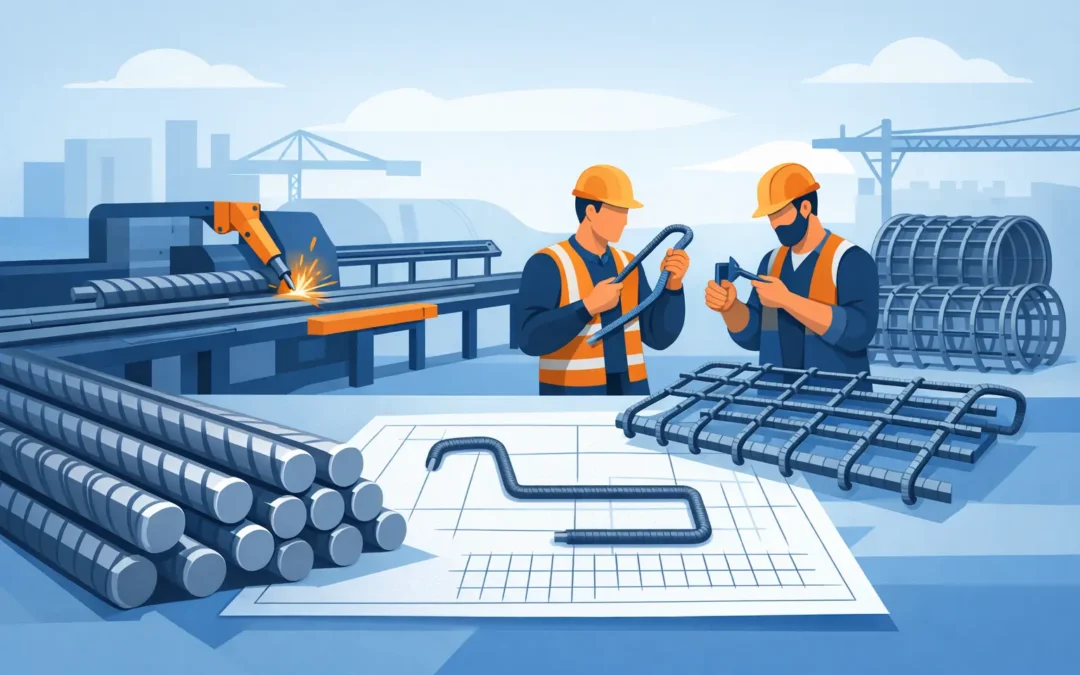
The scope can include straight cut bars, bent bars, links, starter bars, welded mesh assemblies, pre-assembled cages and electro-welded steel frames. The exact requirement depends on the design, the build sequence and the installation method. A housing development may need high volumes of repeatable shapes delivered in phases, while an infrastructure project may require more bespoke fabrication with tighter sequencing and traceability.
This is where fabrication moves beyond supply. A capable fabrication partner is not only processing steel. It is interpreting schedules accurately, maintaining dimensional consistency and preparing loads in a way that supports efficient installation on site.
Why precision matters in reinforcing bar fabrication
Reinforcement is not forgiving when fabrication quality slips. If bends are inaccurate, lengths are wrong or bundles are poorly identified, the problem often appears at the worst possible time – when steel is being fixed, access is limited and the next trade is waiting.
Precision matters first for structural compliance. Reinforcement has to sit where the engineer intended, with the correct cover, spacing, lap lengths and anchorage. If fabricated bars do not align with formwork or adjoining elements, site teams may be forced into adjustments that affect quality and waste valuable time.
It also matters for labour efficiency. Site fixing teams work faster when the steel delivered matches the schedule and arrives clearly tagged and organised. When bars need sorting, trimming or replacing, installation slows down and supervision demands increase. On a tightly managed programme, even minor friction in reinforcement handling can affect concrete sequencing and labour utilisation.
There is a commercial side as well. Accurate fabrication reduces excess material, unnecessary recuts and duplicate orders. That helps control cost, but it also improves housekeeping and safety. Fewer loose lengths and fewer ad hoc alterations generally mean a cleaner, more controlled work area.
The process behind fabricated reinforcement
A dependable fabrication process starts long before steel reaches the machine line. It begins with order review. Drawings, schedules, quantities and delivery phases need to be checked carefully so that fabrication reflects the latest approved information. If there are ambiguities in the schedule, they are far easier to resolve before production than after delivery.
Once requirements are confirmed, the steel is cut and bent according to specification. At this stage, machine calibration and operator oversight are equally important. Automated equipment supports consistency and throughput, but quality still depends on disciplined production controls and checks against schedule data.
After fabrication, identification and bundling are not minor admin tasks. They are operational essentials. Bars must be labelled and grouped in a way that allows site teams to receive, store and install them without confusion. For phased projects, the sequencing of loads matters almost as much as the accuracy of the bars themselves.
Delivery is the final part of the fabrication chain, not a separate issue. A well-fabricated order that arrives late or out of sequence can still disrupt a project. That is why experienced suppliers treat logistics, load planning and communication as part of the overall reinforcement service.
What buyers should expect from a fabrication partner
For professional buyers, the question is rarely whether fabricated reinforcement is useful. It is whether the supplier can deliver it consistently under real project conditions. That means looking beyond price per tonne.
The first expectation should be technical reliability. A fabrication partner should be able to work confidently from schedules and drawings, manage standard and bespoke requirements, and maintain repeatable production accuracy. This is especially important where projects involve multiple pours, varied bar shapes or pre-assembled reinforcement components.
The second is quality control. Fabrication quality should be built into the production process rather than checked only at the point of dispatch. Material traceability, dimensional verification and disciplined handling all contribute to confidence on site.
The third is service continuity. Construction schedules change, release dates shift and priorities move. A supplier that communicates clearly, adapts where needed and keeps delivery commitments gives project teams far more than steel. It gives them predictability.
For businesses such as Marsa Rebar Ltd, that partnership model is central. Contractors and developers are not simply buying fabricated bars. They are relying on a reinforcement specialist to support programme certainty, reduce friction on site and maintain standards across the project lifecycle.
Common challenges and where fabrication adds value
Not every project needs the same fabrication approach. A straightforward job with repetitive reinforcement requirements may benefit most from production efficiency and scheduled call-offs. A more complex build may depend on bespoke bar shapes, cage assemblies or staged deliveries into restricted access areas.
One common challenge is design revision. If schedules change after production has started, the supplier must respond quickly and transparently. In these situations, strong coordination matters more than ideal theory. The best outcome often depends on what has already been fabricated, what can be reallocated and what needs urgent replacement.
Another challenge is site storage. Projects with limited laydown space cannot afford poorly sequenced deliveries. Fabrication adds the most value when it is aligned with installation order, so steel arrives in manageable loads that reduce double handling and congestion.
There is also the issue of waste. Some teams still assume site cutting offers flexibility, but flexibility often comes at the cost of consistency, time and material control. Off-site fabrication usually delivers better results where schedules are clear and programme pressure is real. That said, there are cases where a limited amount of site adjustment remains sensible, particularly on highly variable or alteration-heavy work. The right approach depends on the job, but avoidable site fabrication is rarely the most efficient option.
How fabricated reinforcement supports safer, smoother projects
Safety and productivity are closely linked in reinforcement work. When bars are delivered ready to fix, crews spend less time carrying out improvised cutting or bending activities on site. That reduces manual handling issues, limits unnecessary processing and helps maintain a more orderly working environment.
Fabricated and correctly bundled reinforcement also improves installation planning. Site managers can allocate labour more effectively when they know the right material is arriving in the right sequence. Procurement teams benefit too, because clearer planning usually means fewer urgent requests and less reactive purchasing.
For engineers and developers, the advantage is confidence. Fabrication done properly supports the structural intent of the design while helping the build progress as planned. It is one of those services that is most noticeable when it fails, but highly valuable when it works exactly as it should.
Choosing reinforcing bar fabrication with long-term value
The strongest fabrication service is not defined only by equipment capacity. It is defined by how well production, quality control and logistics work together. Fast output has limited value if bundles are mislabelled. Competitive pricing has limited value if lead times are unreliable. What buyers need is a fabrication partner that can deliver accurate steel, in the correct sequence, with dependable communication throughout.
That becomes even more important on repeat developments and framework-style supply relationships. Consistency over time allows site teams to work with fewer surprises and gives procurement greater confidence when planning releases and forecasting material demand.
Reinforcing bar fabrication is, at its best, a practical advantage built into the structure before the concrete is poured. When the steel is cut correctly, bent accurately and delivered in step with the programme, the whole project feels more controlled. For construction teams working to demanding deadlines, that kind of certainty is not an extra. It is part of building properly.