
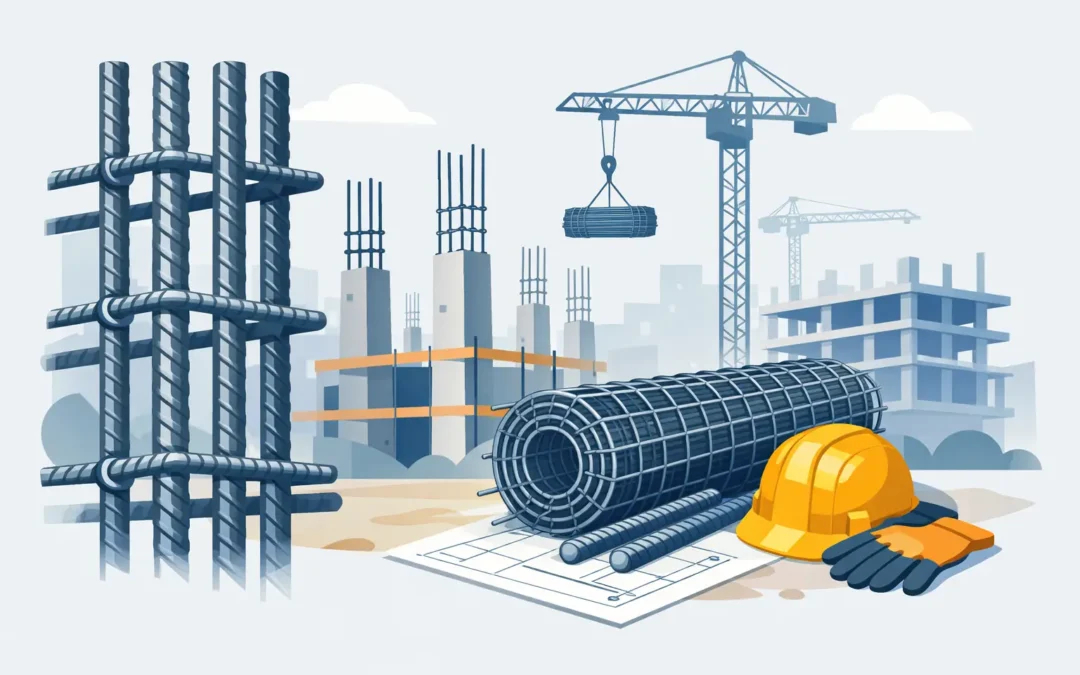
Concrete rarely fails because it cannot carry weight in compression. It fails when real site conditions introduce tension, movement, vibration, shrinkage or load changes that plain concrete cannot absorb well. That is where the question of what is reinforcing steel becomes commercially important – because the answer affects structural performance, fabrication accuracy, programme reliability and long-term durability.
Reinforcing steel is steel placed within concrete to improve its ability to resist tensile forces. In practice, it is the embedded framework that helps concrete perform as a structural material rather than a brittle one. You will usually see it specified as rebar, welded mesh, links, cages or engineered steel assemblies designed to match the structural drawings.
For contractors, developers and engineers, reinforcing steel is not simply a commodity. Its grade, shape, spacing, cover, fabrication quality and delivery condition all influence how efficiently a project moves from detailing to installation.
What is reinforcing steel and why is it used?
Concrete is strong under compression, which makes it ideal for foundations, slabs, columns and retaining structures. Its weakness is tension. When a slab bends, a beam spans, or a wall retains pressure, part of the concrete section is placed under tensile stress. Without reinforcement, cracking can develop quickly and structural behaviour becomes less predictable.
Reinforcing steel is used because steel handles tension far better than concrete and works well alongside it. The two materials also have similar thermal expansion characteristics, which helps them act together under changing temperatures. Once the steel is correctly embedded and the concrete has proper cover, the resulting element can carry higher loads, control cracking and maintain stability over time.
That is the technical reason. The practical reason is equally important. Reinforcement allows designers to create slimmer sections, longer spans and more efficient structural systems than plain concrete would permit on its own.
How reinforcing steel works inside concrete
The bond between steel and concrete is what makes reinforcement effective. Ribbed bars are designed so the concrete grips the bar surface as the material cures. When the concrete element is loaded, tensile forces are transferred into the steel, while compressive forces remain largely within the concrete.
This shared action is why detailing matters. A bar that is the wrong diameter, bent inaccurately or placed with poor cover does not perform in the same way as one fabricated and installed to specification. Even small deviations can create knock-on effects at congested junctions, starter bar locations or beam-column connections.
On site, reinforcing steel also helps manage cracking caused by shrinkage and temperature movement. It does not eliminate cracks entirely – nor is that usually the design aim – but it controls where they form and how wide they become. That distinction matters in basements, water-retaining structures, exposed concrete and durability-sensitive environments.
Common forms of reinforcing steel
When people ask what is reinforcing steel, they often picture straight bars stacked in bundles. In reality, reinforcement is delivered in several forms depending on the structure, the design and the installation sequence.
Cut and bent rebar is used where the reinforcement schedule calls for precise shapes, lengths and bend radii. This is standard across beams, slabs, footings, walls and columns. Welded mesh is widely used for slabs and surface reinforcement where speed and consistent spacing are priorities. Links and stirrups provide confinement and shear resistance in beams and columns. Pre-assembled cages reduce assembly time on site and improve installation efficiency where repetition or complexity makes loose bar fixing less practical.
Electro-welded frames and bespoke reinforcement assemblies are particularly useful when labour access is tight, geometry is repetitive or programme pressure is high. In these cases, off-site fabrication can reduce handling, improve consistency and shorten installation windows.
What affects reinforcing steel performance?
Not all reinforcement performs equally well in live project conditions. The steel itself must meet the required specification, but fabrication and logistics are just as important.
Bar grade is one factor. Higher-grade steel can improve design efficiency, but only if it is correctly specified and detailed. Bend accuracy is another. Poorly bent bars can create fixing delays, force site modifications and introduce quality risks. Dimensional tolerance matters because reinforcement must fit formwork, openings, service penetrations and lap zones exactly as intended.
Surface condition also plays a role. Reinforcement should be clean enough to achieve proper bond, and storage or handling should prevent unnecessary contamination or distortion. Cover is equally critical. Too little cover can expose steel to corrosion risk, while too much can compromise structural behaviour or crack control.
Then there is coordination. Reinforcement is often one of the first real tests of whether the structural design, fabrication output and site team are working in step. If schedules are unclear or deliveries arrive out of sequence, delays spread quickly through shuttering, concrete pours and follow-on trades.
Why fabrication quality matters more than many teams expect
In theory, reinforcement is straightforward: manufacture to the bar bending schedule and deliver to site. In practice, the quality of fabrication can directly affect cost, safety and programme certainty.
Accurate cut and bent steel reduces the amount of rework needed by fixers. It lowers the risk of bars being forced into place, cut on site or replaced at short notice. That improves productivity and helps preserve the engineer’s intended detailing. It also reduces waste, which matters commercially on large packages where small inefficiencies multiply across multiple pours.
For procurement teams and project managers, the benefit is not only product quality but operational reliability. Reinforcement that arrives labelled correctly, bundled logically and sequenced for installation is easier to receive, inspect and place. That level of control is often the difference between a smooth pour preparation and a lost day on site.
This is why specialist fabrication partners add value beyond material supply. A dependable supplier supports planning, identifies practical detailing concerns early and helps maintain continuity from order through to delivery. For projects under tight timelines, that support can protect far more than the reinforcement package alone.
Compliance, durability and the real cost of getting it wrong
Reinforcing steel sits inside the structure, which can create a false sense that errors will remain hidden. In reality, reinforcement mistakes tend to surface later as delays, non-conformances, remedial work or durability issues.
If reinforcement is missing, incorrectly placed or not fabricated to drawing, the risk is not merely technical. It can stop inspections, postpone concrete pours and affect downstream trades. Corrective work once concrete is cast is far more disruptive and expensive than getting the steel package right at the outset.
Durability is another concern. In coastal or exposed environments, poor cover, congestion or inadequate detailing can increase the likelihood of corrosion over time. Once corrosion begins, expansion of the steel can crack and spall the surrounding concrete, weakening the section and triggering repair costs that far exceed the original saving made through poor-quality supply or rushed installation.
Trusted reinforcement supply is therefore about more than procurement efficiency. It supports compliance, structural integrity and asset life.
What buyers should look for in a reinforcing steel partner
A reinforcement package should be judged on more than price per tonne. For experienced construction buyers, the better question is whether the supplier can support the project with consistent accuracy, dependable production and delivery coordination that matches the build sequence.
That means looking at fabrication capability, quality control, lead time discipline and the ability to handle both standard and bespoke reinforcement. It also means assessing whether the supplier communicates clearly when drawings change, quantities shift or programme pressure increases.
On complex projects, responsiveness matters. A supplier that can adapt to revisions, produce precise assemblies and maintain traceable delivery arrangements helps reduce site friction. Marsa Rebar operates in exactly that space, supporting contractors and developers with reinforcement solutions built around fabrication accuracy, dependable logistics and service continuity.
What is reinforcing steel in practical project terms?
In practical terms, reinforcing steel is the framework that allows concrete structures to perform safely under real loads and real site conditions. It is the shaped, scheduled and carefully placed steel that gives beams their tensile strength, columns their confinement, slabs their crack control and foundations their resilience.
Its value is not only in the metal itself, but in the precision behind it – the detailing, the fabrication, the sequencing and the delivery discipline that allow it to be installed correctly the first time. For commercial construction teams, that is where quality becomes measurable: fewer delays, less waste, smoother installation and greater confidence that the structure will perform as designed.
When reinforcement is specified well and supplied by a partner who understands project execution, it stops being a hidden line item and becomes one of the quiet drivers of build quality.